

Moving From Ontario to Vancouver Island: What 4,000 km Does to a Move
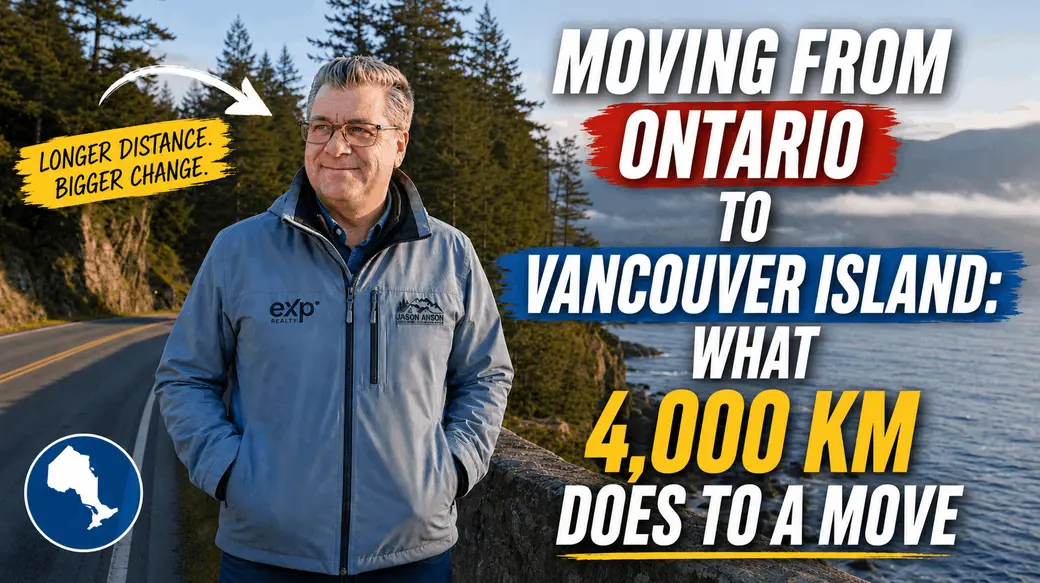
Relocate to vancouver island from Ontario and the move becomes a logistics project before it becomes a lifestyle change.
The distance is long enough that you do not casually run back for the things you forgot.
Your furniture, vehicle, pets, records and possessions all have to cross the country, then the final leg may include a ferry.
That changes how I would plan the move. I would decide what deserves to travel before deciding how to move it.
What to know before you read further
- An Ontario to Vancouver Island move is long distance and usually adds a ferry or Island flight to the final stage. • Ontario households spent an average of $81,975 on goods and services in 2023, while British Columbia households averaged $82,657.2 • British Columbia household shelter spending averaged $28,739 in 2023, compared with $29,323 in Ontario based on the published provincial shares and totals.2 • Vancouver Island housing varies enough that Greater Victoria, Nanaimo and Campbell River should not be treated as one destination.34 • Moving fewer possessions can be more valuable on a cross country relocation when the replacement home will be smaller.
The Distance Forces Better Decisions
A cross country move punishes indecision.
Every chair, box and piece of garage equipment has to justify the space it takes.
That can be useful.
If you are moving in your senior years, this is a chance to decide what the next home is supposed to do.
Do you still want a large detached house?
Do you want stairs?
Do you want a yard?
Do you need storage for equipment you no longer use?
Do you want a condo that can be locked and left while you travel?
The cost of moving individual belongings is [UNSOURCED] because it depends on volume, mover, origin, destination and service level. Written quotes from licensed moving companies would verify your actual cost.
I would use the distance as a filter.
Move the things that belong in the next life.
Do not pay to move the previous house across the country.
The Ferry Is the Last Part of a Very Long Move
The biggest change is not the weather.
It is the water between you and the mainland.
On the mainland, a long drive is still a drive. On Vancouver Island, many trips to Metro Vancouver include a ferry reservation, a terminal arrival and a sailing.
BC Ferries lists a 2026 at terminal fare of $110 for a standard vehicle and driver on the major Metro Vancouver and Vancouver Island routes, before the applicable fuel adjustment.1
Advance Saver fares can be lower on selected sailings.1
That turns mainland travel into a line in both the calendar and the budget.
If you have family, work or medical commitments on the mainland, I would decide how often you expect to cross before choosing where to live.
Nanaimo gives you direct access through Departure Bay and Duke Point.
The south Island uses Swartz Bay for the main Tsawwassen connection.
Where you live on Vancouver Island changes the trip before the ferry even begins.
Ontario and British Columbia Household Spending Is Surprisingly Close
Statistics Canada’s 2023 household spending survey reported average spending on goods and services of $81,975 in Ontario and $82,657 in British Columbia.2
That is a difference of $682 in those provincial averages.2
The categories were not identical.
Shelter represented 35.8 per cent of Ontario household spending and 34.8 per cent in British Columbia.2
Transportation represented 14.6 per cent in Ontario and 15.2 per cent in British Columbia.2
Food represented 14.4 per cent in Ontario and 14.7 per cent in British Columbia.2
These are provincial averages, not relocation quotes.
Toronto is not all of Ontario.
Victoria is not all of British Columbia.
The useful point is that the province level totals are much closer than the stereotypes suggest.
Your housing choice on Vancouver Island will matter far more than the provincial label.
Choose the Island Region Before You Book the Mover
The latest board figures make the regional gap visible.
In the Vancouver Island Real Estate Board area, the June 2026 benchmark for a single family home was $680,900 in Campbell River, $816,400 in Nanaimo, $864,500 in the Comox Valley and $929,500 in Parksville and Qualicum.1
Those are benchmark figures for a typical home, not price tags for every property.
Greater Victoria sits in a different price tier. The Victoria Real Estate Board reported a June 2026 benchmark of $1,326,500 for a single family home in the Victoria Core.3
That spread is why a statement such as Vancouver Island is expensive is not very useful.
The Island contains several housing markets.
A household that cannot make the Victoria Core work may still have options farther north or west. A household that can afford Victoria may still choose another region because it wants more land, a quieter daily routine or a different connection to the outdoors.
Price opens the conversation.
It does not finish it.
If you are leaving the Greater Toronto Area, the Victoria Core may still feel familiar in price compared with some Ontario markets.
If you are leaving a smaller Ontario community, it may not.
Nanaimo, Campbell River, the Comox Valley, Port Alberni and the Cowichan Valley create different entry points.
I would choose the region first because the destination affects the move.
A Nanaimo destination can use the central Island ferry routes.
A Victoria area destination normally pulls toward Swartz Bay.
A north Island destination adds a significant drive after you reach Vancouver Island.
That matters when a moving truck is involved.
The final address is not a small detail at the end of the trip.
It shapes the logistics.
Do Not Ship a Car Without Deciding Whether You Need It
Outside the most walkable parts of Greater Victoria, I would be cautious about giving up a vehicle too early.
BC Transit operates networks across several Island regions and interregional routes between Cowichan and Victoria and between Nanaimo and Cowichan.5
That is useful.
It does not mean every neighbourhood supports a car free life.
If you are moving from Toronto or Ottawa and are used to deeper urban transit, the difference can be significant.
If you are moving from rural or suburban Ontario, the transition may feel smaller.
I would test the actual address.
Walk to the nearest grocery store.
Find the bus stop.
Check the route to the hospital.
Price a taxi.
Then decide how many vehicles the household needs.
Shipping or replacing a vehicle is a real cost, but so is living in the wrong location without one.
Health Care Should Influence the Landing Point
Long distance relocation can separate you from an established network of doctors, specialists and pharmacies.
That makes the first Island address important.
Island Health operates hospitals and health services across Vancouver Island.6
The level of service is not identical in every community.
If you have regular appointments, I would map where those services are likely to happen before choosing a remote property.
This is especially important when you plan to age in place.
A house can be physically accessible and still be poorly located for health care.
I would rather see someone choose a slightly smaller home closer to the services they expect to use than buy extra space that turns every appointment into a long trip.
The move is already long.
Your permanent routine does not have to be.
Family Distance Becomes More Real
Ontario family is not a ferry ride away.
It is a flight across the country.
That changes spontaneous visits.
Airport access therefore deserves more weight than it might for someone moving from Vancouver.
Victoria International Airport, Nanaimo Airport and Comox Valley Airport serve different parts of the Island.
Current nonstop Ontario routes and frequencies are [UNSOURCED] because airline schedules change. The airports and airlines would verify current service for your travel dates.
I would compare the whole trip to the family member you expect to visit most.
Door to airport.
Parking.
Flight.
Connection if required.
Ground transportation at the other end.
A cheaper house farther from the airport may still be right.
Just make the distance visible before you buy it.
Provincial Rules Change When You Cross the Border
British Columbia has its own property transfer tax, income tax and housing programs.
The general property transfer tax is 1 per cent on the first $200,000 of fair market value, 2 per cent on the portion above $200,000 up to $2,000,000, and 3 per cent on the portion above $2,000,000.7
A further 2 per cent applies to the residential value above $3,000,000.7
Exemptions can apply in qualifying situations, so I would not calculate a final tax bill from those rates alone.
For homeowners, the 2026 home owner grant threshold is $2.075 million.8
Those are the kinds of provincial details that belong in the relocation budget before you set the maximum purchase price.
Arrive With Less and Give Yourself Time
The best Ontario to Vancouver Island move does not have to end with a permanent house immediately.
Renting first can make sense when you genuinely do not know the Island.
Current rental prices by community are [UNSOURCED]. Canada Mortgage and Housing Corporation rental data and current local rental listings would verify the market you are entering.
The advantage is knowledge.
You learn whether Nanaimo feels central or spread out.
You learn whether Victoria is too urban.
You learn whether the Cowichan Valley is the right scale.
You learn how often you actually use the ferry.
You learn how far you are willing to drive.
A cross country move already contains enough irreversible decisions.
The final neighbourhood does not have to be one of them on the first day.
FAQ
how hard is it to relocate from ontario to vancouver island?
The distance makes planning more important, but the move is straightforward when you separate it into downsizing, transport, the cross country leg and the final Island leg. I would choose the exact Island region before booking movers because the destination changes ferry and driving logistics.
is british columbia much more expensive than ontario?
The 2023 Statistics Canada household survey showed very similar provincial averages for total goods and services spending, $81,975 in Ontario and $82,657 in British Columbia.2 Individual housing markets vary far more than that provincial comparison suggests.
should i rent first after moving to vancouver island?
If you do not know the Island, renting can reduce the risk of choosing the wrong region. It gives you time to test ferry use, health care access, driving distances and the daily rhythm before committing to a permanent home.
Sources
- BC Ferries, 2026. Major route fare index, effective June 2026. [2] Statistics Canada, 2025. Survey of Household Spending, 2023 provincial results. [3] Vancouver Island Real Estate Board, 2026. June 2026 MLS Home Price Index area benchmarks. [4] Victoria Real Estate Board, 2026. June 2026 MLS Home Price Index. [5] BC Transit, 2026. Vancouver Island interregional routes. [6] Island Health, 2026. Hospitals and health services on Vancouver Island. [7] Province of British Columbia, 2026. Property transfer tax rates. [8] Province of British Columbia, 2026. Home owner grant program. bcferries.com
Categories
- All Blogs (208)
- BC Property Tax Search (10)
- Cost of Living in the Cowichan Valley (3)
- Cost of Living in the Pacific Rim (3)
- Cost of Living on Central Vancouver Island (3)
- Cost of Living on Cowichan Lake (3)
- Cost of Living on North Vancouver Island (3)
- Cost of Living on South Vancouver Island (3)
- Cost of Living on the Gulf Islands (3)
- Cost of Living on the Surrounding Islands (3)
- Cost of Living on Vancouver Island (5)
- Living in the Cowichan Valley (3)
- Living in the Pacific Rim (3)
- Living in Youbou (3)
- Living on Central Vancouver Island (3)
- Living on Cowichan Lake (3)
- Living on North Vancouver Island (3)
- Living on South Vancouver Island (3)
- Living on the Gulf Islands (3)
- Living on the Surrounding Islands (3)
- Living on Vancouver Island (26)
- Log Homes (3)
- Most Affordable Central Vancouver Island (3)
- Most Affordable Comox Valley (1)
- Most Affordable Cowichan Valley (1)
- Most Affordable Gulf Islands (3)
- Most Affordable in Campbell River (1)
- Most Affordable Nanaimo (1)
- Most Affordable North Island (1)
- Most Affordable North Vancouver Island (3)
- Most Affordable Pacific Rim (3)
- Most Affordable Parksville Qualicum (1)
- Most Affordable South Vancouver Island (3)
- Most Affordable Surrounding Islands (4)
- Most Affordable Vancouver Island (4)
- Most Expensive Campbell River (1)
- Most Expensive Central Vancouver Island (3)
- Most Expensive Comox Valley (1)
- Most Expensive Cowichan Valley (1)
- Most Expensive Gulf Islands (3)
- Most Expensive Nanaimo (1)
- Most Expensive North Island (1)
- Most Expensive North Vancouver Island (3)
- Most Expensive Pacific Rim (3)
- Most Expensive Parksville Qualicum (1)
- Most Expensive Port Alberni Area (2)
- Most Expensive South Vancouver Island (3)
- Most Expensive Surrounding Islands (4)
- Most Expensive Vancouver Island (4)
- Moving to Central Vancouver Island (3)
- Moving to Cowichan Lake Area (3)
- Moving to Cowichan Valley (3)
- Moving to North Vancouver Island (3)
- Moving to South Vancouver Island (3)
- Moving to the Gulf Islands (3)
- Moving to the Pacific Rim (3)
- Moving to the Surrounding Islands (3)
- Moving to Vancouver Island (3)
- People’s Choice Awards (11)
- Real Estate Market Guide (6)
- Vancouver Island Real Estate Market Reports (6)
- Youbou Real Estate Market Reports (3)
Recent Posts










Accurate Home Values. Proven Results.
Whether you are buying, selling or simply working out what your property is worth, the number matters more than the opinion. Market conditions on Vancouver Island shift by community and by month, and a value that was right in the spring may not hold by the fall.
I do not guess your home's value. I prove it, using actual market value and real market movement so you can protect your equity and move forward with confidence. Send me the address and I will show you the numbers.